



Hey👋
Thanks for reading Exec Engineering, a weekly digest for the busy tech executive.
I hope this edition brings you value.
The Digest
Rethinking interviewing in an AI era (Justin Lee / LeadDev)
Real engineering happens in the messy middle between requirements and shipping. Justin Lee’s interview framework reveals why the best signal comes from watching candidates navigate uncertainty and communicate trade-offs, not solve problems AI can answer in seconds. His approach: ask experience-based questions, use simple realistic problems, and guide candidates toward demonstrating thinking rather than testing for right answers.
The CTO Scrooge (Aviv Ben-Yosef)
Most CTOs don't plan to become miserable, they drift from meaningful builder roles into executive positions where meetings replace real work and exhaustion replaces excitement. You can get promoted, earn more, and look successful while being completely drained inside, which is why so many senior tech leaders are unhappy despite their success. The solution requires catching this drift early, deliberately setting your agenda rather than reacting to demands, moving to strategic upstream work, and stop letting the need to be liked drive your decisions.
Micromanagement? Or Staying Close to Reality? (John Cutler / The Beautiful Mess)
Why does asking for team updates trigger micromanagement accusations? John Cutler traces how tech companies adopted empowerment language while building systems where direct visibility feels threatening. We created hierarchies without the cultural support they need. Leaders only engage during reviews or crises. Escalation became risky instead of routine. Teams learned to perform rather than share truth. The pushback wasn’t wrong, it revealed conditions for healthy leadership visibility simply don’t exist.
Don’t be a full cup (Shreyas Doshi)
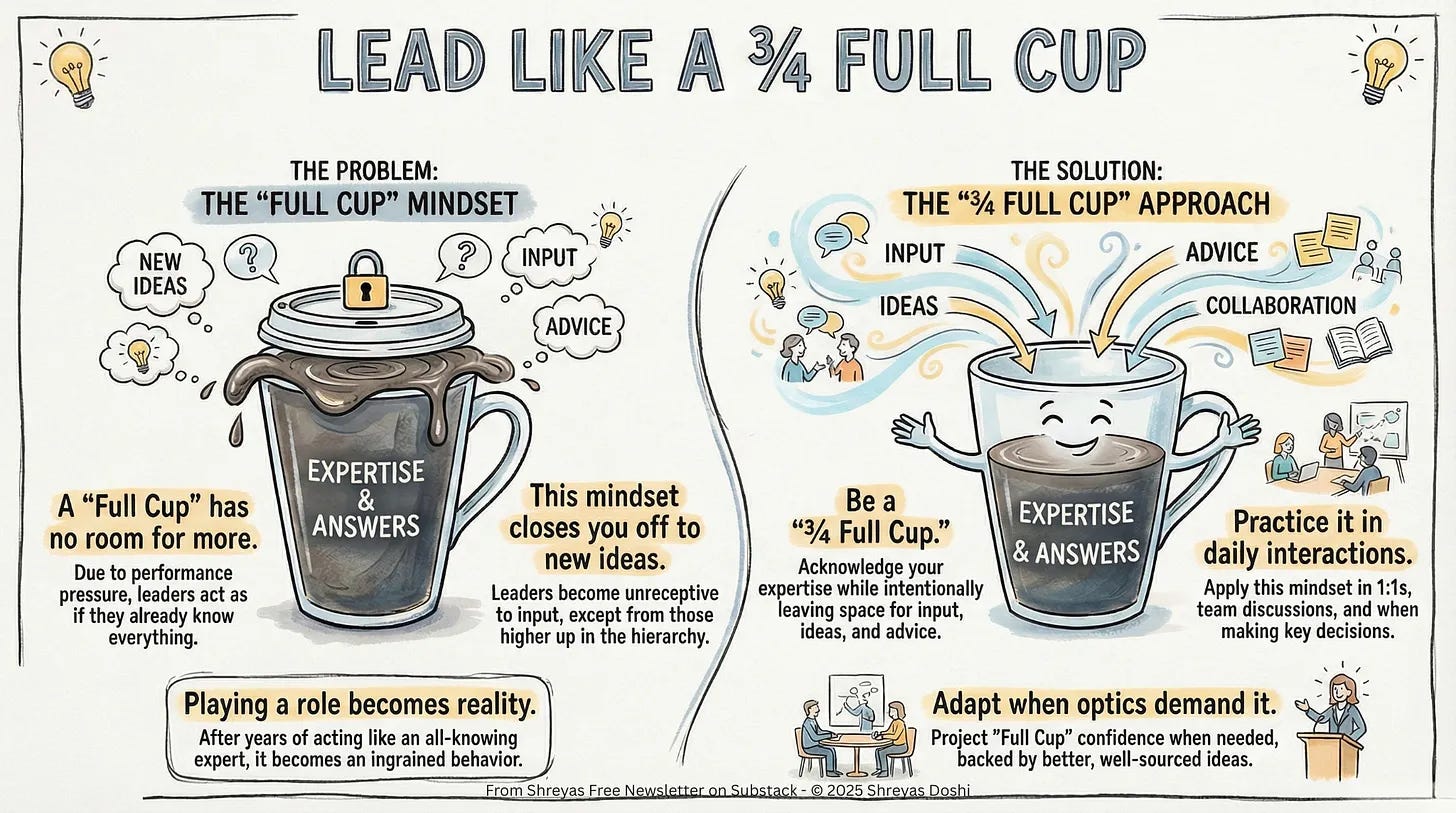
Leaders perform confidence so convincingly that they stop seeking input, close themselves to ideas, and confuse the performance with reality. Shreyas Doshi traces how optics pressure turns you into a "full cup" who has rational explanations for everything and only accepts input from those higher in the hierarchy. His solution acknowledges you sometimes need to manage perception, but suggests operating differently: stay ¾ full in daily interactions like 1:1s and team discussions, deliberately leaving room for input and advice even when it's not offered. Save the full cup performance for staff meetings and moments when optics genuinely require it.
Effective Mentorship and Remote Team Culture (Gilad Shoham interviewed by Shane Hastie)
Gilad Shoham runs a fully distributed team at Bit.cloud without deadlines, time tracking, or micromanagement. His approach is built on hiring people with good judgment, giving them clear boundaries and responsibilities, trusting them completely, and staying available to help rather than monitor. For new leaders, his advice is simple. Learn to delegate, shift from doer to helper, and earn leadership through trust rather than authority.
Teams Drift Apart by Default (Adrian Stanek)
Teams break not from bad intentions but from physics. Under pressure, people take the path of least resistance. The system makes fragmentation effortless while cohesion demands constant energy. The fix isn’t changing attitudes but changing the system itself. Pick one place where your team naturally fragments (like decisions happening in side channels), then add one simple rule that makes working together easier than working apart (like requiring all decisions to be visible to everyone). One boring rule enforced consistently beats ten inspirational value statements.
“Here is a simple measure of cohesion: can any person on the team answer three questions without hesitation? What are we building right now? How do decisions get made? Where do I go when I’m blocked? If those answers depend on who you ask, you don’t have one team; you have multiple maps with multiple capitals.”
How differently do software developers perceive the same communication? (Lizzie Matusov / Research-Driven Engineering Leadership)
Research on 94 developers found two perception groups that interpret 65% of messages differently. One values emotional resonance and casual language. The other prioritizes information density and views informality as unprofessional. These mismatched perceptions cause productivity loss through misunderstood code reviews and damaged trust. Leaders need to help developers recognize when their communication style creates friction with teammates who interpret messages differently.
Fundamentals Still Matter (Bjorn Roche)
AI giants are playing a different game, raising billions on breakthrough potential. Most tech companies have a different strength: proven revenue, real customers, and predictable growth. Understanding your core metrics deeply reveals exactly where your competitive advantages lie. While foundation models chase superintelligence, focus on building a business with solid unit economics and clear growth trajectories. Strong fundamentals give you control over your destiny regardless of where investor sentiment shifts next.
Dialog
Jeff Foster, Director of Technology and Innovation at Redgate Software, argues that waiting for permission is often more expensive than letting teams make the occasional mistake.
In our latest Dialog, Jeff explains why intent-based leadership and Architecture Intent Checks help teams move faster without sacrificing alignment, how context beats control when scaling engineering organizations, and why internal, employee-led conferences can quietly transform learning, confidence, and culture. He also shares a grounded take on AI adoption, one that prioritizes training existing engineers over hype-driven org changes.
Check it out here:

More reads
Seven Big Predictions For Tech in 2026 (Alex Kantrowitz)
Maybe the Default Settings Are Too High (David Cain)
Evil tip: avoid “easy” things (Yossi Kreinin)
Work Expands. Time Vanishes. Here’s Why. (Michał Poczwardowski)
Building an internal agent: Adding support for Agent Skills (Will Larson)
This digest is supported by Gemography.

Support your engineering team with remote high-ownership engineers from Africa and LatAm, on demand. Meet precise matches for your stack and culture under 48h.
About Exec Engineering
I’m Yassine 👋 I spend a big chunk of my time digging into engineering management and talent acquisition, especially where the two overlap. I share the most interesting resources I come across in this newsletter, all curated by hand.