

Staying Hands-on Without Becoming a Bottleneck | Rodrigo D. A. Senra, VP of Engineering, Loadsmart

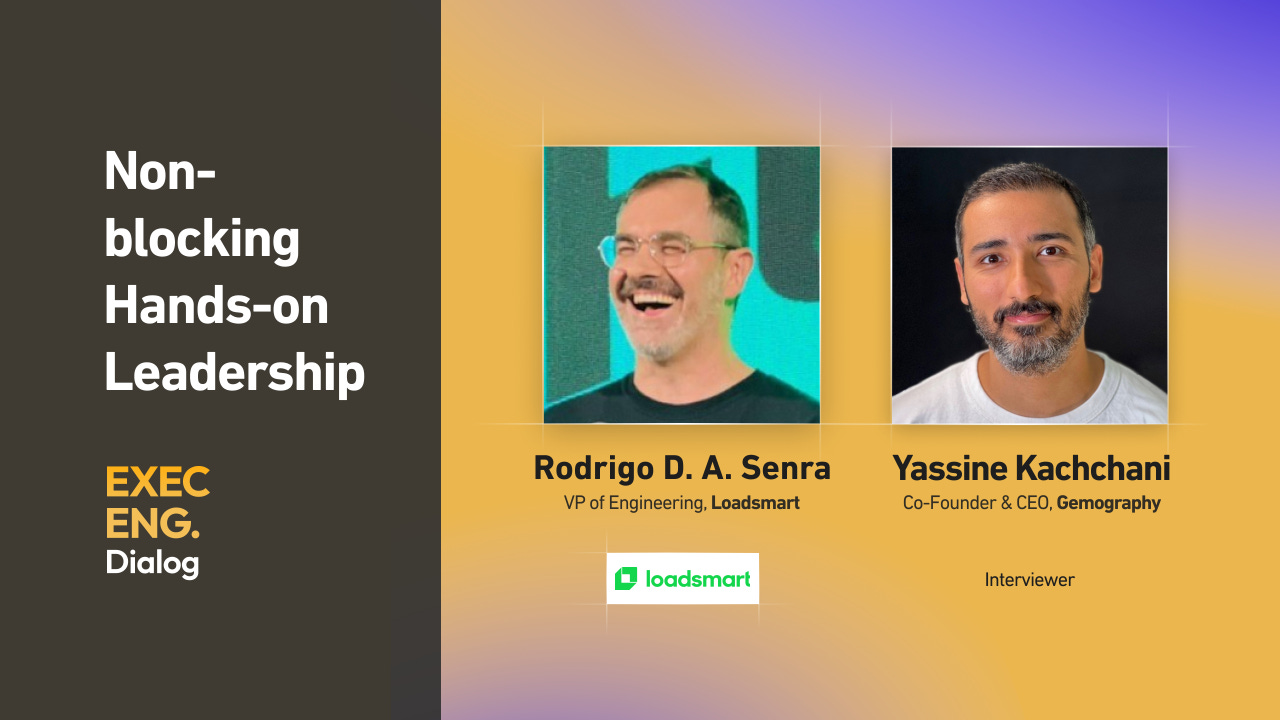
This week’s Dialog guest is Rodrigo D. A. Senra, VP of Engineering at Loadsmart. He has built AI-driven products spanning consumer wearables and logistics infrastructure.
Before Loadsmart, he held senior engineering leadership roles at Work & Co, where he led technology for products like the CES award-winning Gatorade Gx platform. He is also a named inventor on multiple U.S. patents related to data systems and information management, both assigned to EMC.
Takeaways
When hiring for specialized domains, unfamiliarity with the domain shouldn’t block prioritizing engineering excellence. Product teams can educate engineers on business needs, and domain knowledge builds through collaboration over time.
Staying hands-on as VPE through PoCs, hackathons, and data analysis for non-tech teams maintains technical credibility while without the critical path.
Cross-industry moves mean rebuilding business acumen from scratch. Technical foundations and people skills transfer across domains, but understanding what’s relevant, where pitfalls hide, and where opportunities emerge requires fresh learning in each new industry.
Yassine: You spent years at Work & Co building products like the Gatorade Gx Sweat Patch, a CES award-winning wearable for athletes. Then you joined Loadsmart to build AI for freight logistics. That’s a wild domain jump. For other engineering leaders considering moves between completely different industries, say, fintech to healthcare, or e-commerce to manufacturing, what do you think is actually portable about technical leadership, and what’s just domain-specific knowledge you have to rebuild from scratch?
Rodrigo: People (aka Soft) skills are very portable, what is essential in human communication and cooperation remains the same across industries. Technology (as in a particular choice of tech stack or tooling) may change from one Industry to another but the foundations of Engineering, Computer Science or Data Science/Analytics remain the same.
What needs to be rebuilt is the business acumen that is specific to a given Industry, such as what is relevant, pitfalls, and opportunities. For example, in the Gx project it was very important to handle gender information so we had validity for the regression models that extrapolate whole body sweat rate from the capture of a single pore. In freight logistics pricing a lane is very volatile, and there is no right or wrong price, correctness is very contextual. These business nuances are not portable, and need to be learned.
Yassine: At Loadsmart, you’re building AI products like Freight Intel AI (the voice-driven analytics tool) and NavTrac (the computer vision system). When you’re hiring for a specialized domain like logistics AI, how do you think about hiring for freight domain knowledge versus just hiring great engineers who’d figure it out?
Rodrigo: As VP of Engineering, I am mainly focused on Engineering excellence, so my perspective is centered on hiring engineers with mastery of our discipline, and we have peers in the business (Product discipline) that will educate and prioritize our Engineering work towards business needs.
As time goes by, engineers acquire more business acumen, and Product managers and leaders get more insight into technological aspects. But at the hiring phase, my focus is to hire for the job role, and knowledge beyond that is a plus, not a requirement.
Yassine: Beyond technical mastery, what would you say are your non-negotiables for hiring engineers?
Rodrigo: I will go for the trio of values that I cultivate myself:
Curiosity
Technology is always in motion, only an insatiable curious mind can thrive in this ever-changing environment.
Team work
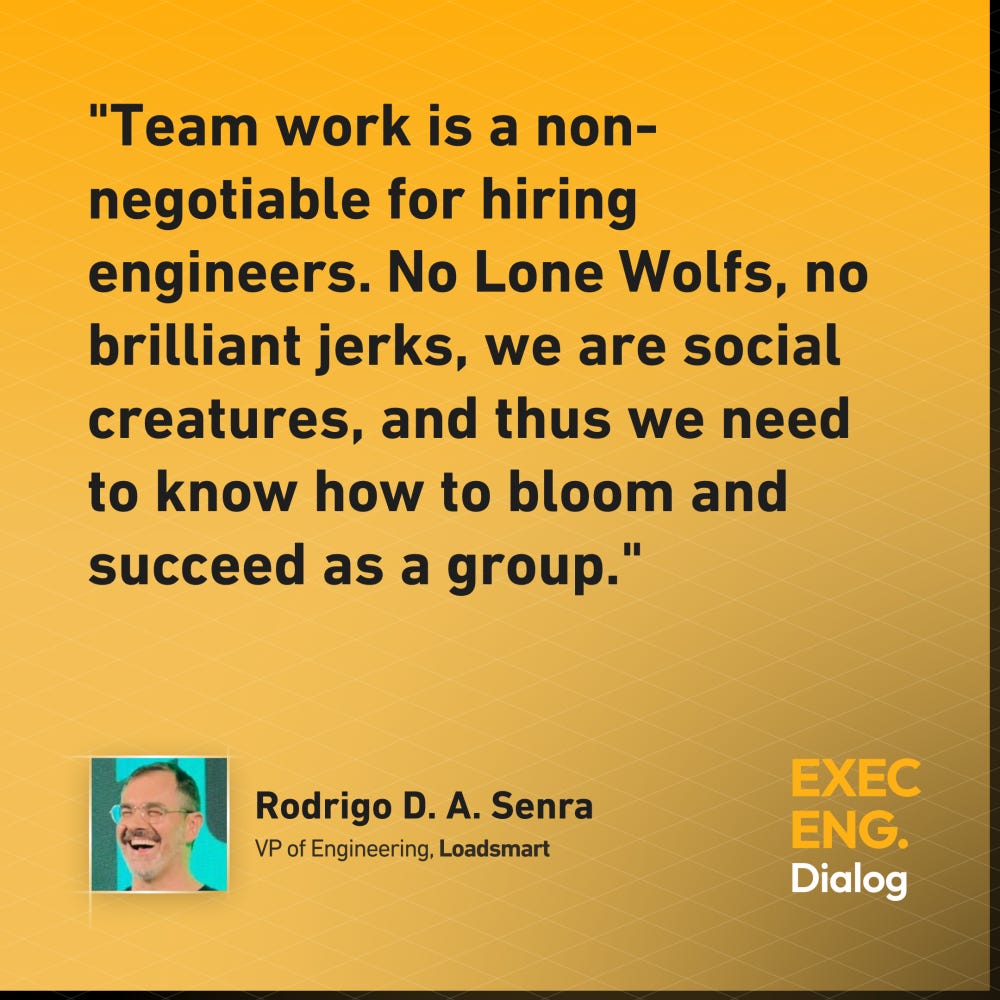
No Lone Wolfs, no brilliant jerks, we are social creatures (according to Aristotle) and thus we need to know how to bloom and succeed as a group
Technical Excellence
Ultimately, the engineering goal is technical excellence achieved by study, practice and ingenuity.
Yassine: You’ve maintained technical credibility with ICs even as VP by being very hands-on. What does “hands-on” actually look like for you as VP, and where do you draw the line between staying connected versus blocking your team from growing?
Rodrigo: As a manager, I avoid being on the critical path for anything in the SDLC, so I am not a bottleneck for Engineers moving Tasks/Stories/Epics forward. Having said that, I strive to be as knowledgeable as possible in the tooling and services, knowing the codebase, participating in braintrusts, and architecture/code reviews.
Another way to participate without interfering is by doing PoC, joining Hackathons, or Coding dojos. Last but not least, I sometimes act as a Data Scientist for sectors of the business that have no development supporting team, such as Legal, Finance, or HR. I did data analysis to support lawsuits or helped in the migration of HR systems as a few concrete examples.
Yassine: You did your PhD while working in industry, which meant you were already balancing async research work with real-time production demands. What’s one pattern or habit from that academic experience that’s served you well as an engineering leader?
Rodrigo: In Tech study never stops, and from Academia we are trained to stay curious and do a lot of research before acting. So, I’ve kept my ACM subscription to have access to the ACM Digital Library and consume research papers to deep dive into the tech.
Yassine: What’s one async pattern or habit you’d recommend to most teams, even if they’re fully co-located?
Rodrigo: On the async aspect of the question, we use Slack, email, GDocs and other digital documentation tools as buffers to accommodate async interactions, but we insist on having some sync rituals that consolidate the sense of team unity. And at least once a year we do organize meetups for people to meet face to face and renew professional bonds and allegiances.
Yassine: You taught MBA students at IAG while running engineering at Loadsmart. For most VPs, that would be impossible time-wise. What about your setup makes it sustainable to teach while leading engineering?
Rodrigo: The MBA is an online course solving the commuting problem, i.e. classes can be given from home. Moreover, it has 2 modalities, a short one and a longer one, which respectively mean a workload for me of 6hrs or 18hrs.
In the first year, when you have to prepare the course material that invades a bit of family space and weekends, in the following years, there is less time spent to keep the material up-to-date, and that amount of time in-the-classroom is much easier to accommodate. Classes take place at night because students usually work on regular business hours, so there is no clash with my employer’s appointments.
📚 Rodrigo Senra’s Go-To Resources:
3 people you follow and recommend:
3 podcasts I make time for:
I recommend Founders from David Senra (not a relative)
Newsletters I rarely skip:
Books that shaped my thinking:
Thank you Rodrigo for your time and insights!
This interview is part of the “Exec Engineering Dialog” series where I interview seasoned tech leaders on the topics of talent, product, management and culture.
If you liked the insights shared in this interview, consider giving feedback and/or sharing it with your network, it’s the best way to help this segment improve and grow.
Yassine.